
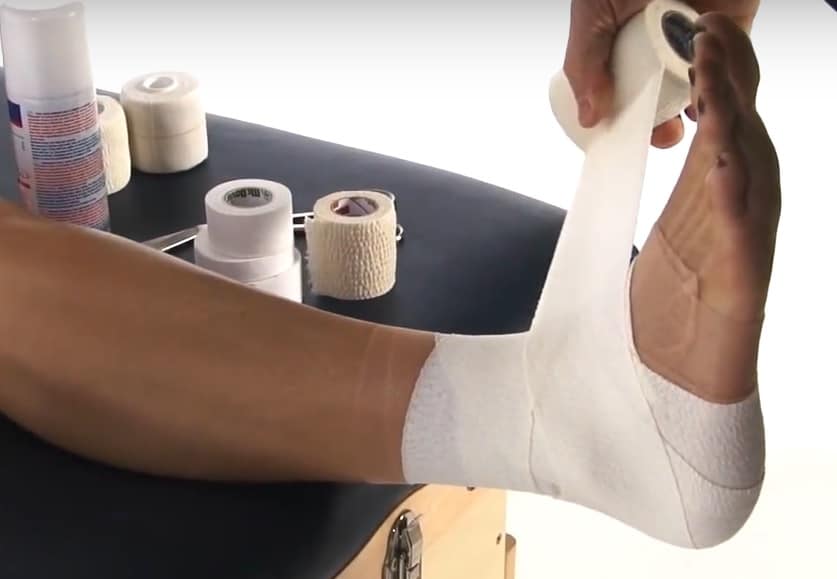
Tape is everywhere. If you go into the changing room of any sporting team (local league or elite level) and there will be someone applying tape. Be be it good old electricians tape, elastic adhesive bandage (EAB), traditional zinc oxide, or the new fandangled K-tape or equivalent. Athletes (and indeed some non athletes) are reliant on the stuff.
This article is part of series of articles looking at the truth behind the treatments physios generally use. This one will focus on traditional taping and I will write a further one concerning kinesio tape. They will both discuss whether they work, how they might work and also whether there are untruths about their use. Some of what is said is science based whilst others are based on my opinion and clinical experience. I hope it allows you to make an informed decision about whether taping is for you.
Traditional taping
By traditional taping I mean taping to provide stability to a joint using EAB or zinc-oxide tape. There are techniques for most joints from the little toe right up to shoulder stabilisation and often several different techniques for the same joint, some being more complex than others. It is beyond the remit of this post to discuss each one separately.
They work on a concept of joints being unstable with the tape giving some stability by restricting the joints movement. Some would also say they aid proprioception increasing feedback so your body knows where your joint is and will stop it going to far to prevent injury. Does it work? Yes, I certainly think there is premise in traditional taping strategies. Evidence would also support that it can reduce pain and prevent injuries.
I will say however some tapes are better than others (for me EAB alone is pointless). Some techniques are better than others and some joints are more suitable than others. For example providing stability at the ankle joint is more likely to be achieved with tape than stability at the shoulder joint due to the larger range of movement and muscular forces involved at the shoulder. Don’t even get me started on taping of the spine.
Tape alone isn’t going to prevent injuries. The tape can only provide so much stability. If the forces are large enough to cause tissue damage there is no way a piece of tape is going to hold up. Our tissues have ridiculous tensile strength compared to tape. Furthermore any rigidity applied during the taping application will get stretched once sport is commenced.
That said I admit that I tape my thumbs when playing rugby. I know that is not necessarily going to stop me injuring them (indeed I have injured them whilst taped) but it gives me a bit more confidence aiding performance. This is another area where taping can be beneficial but remember losing mobility can restrict performance also.
My caution with using traditional method as a therapist is that the athlete becomes dependent on it. When there is no tape available or the taper is away it can leave the athlete feeling vulnerable (never good). This is an important factor to take into account when deciding whether to tape or not. Importantly for me if an athlete is taping then it is important that they can tape it themselves and that they also rehab to strengthen the area.